Verticals Public sector & defense
Public sector & defense on one shared ontology
Commands and agencies don’t share systems — but public missions force shared meaning. Zenith layers a governed knowledge graph above the stacks you already run: evidence-grounded personnel support in closed environments, and policy-backed Go/No-Go when minutes matter.
The problem
Public AI fails when every system keeps a private picture of the same people and missions
Personnel records sit in one stack. Regulations live in PDFs. Incident feeds chart a dashboard. Agents still guess. The break is meaning — not another interface on the same silos.
-
Shared mission ontology
People, posts, units, hazards, assets, obligations, and policy become first-class entities — the same meaning across commands, agencies, and the systems they already run.
-
Deterministic policy packs
Statutes, directives, and operating manuals become measurable gates. Unverified drafts never weigh the same as asserted knowledge — every recommendation lists evidence and unmet conditions.
-
Ground, then act
Agents retrieve against a governed graph, then cite. High-impact actions stay behind permission checks and human gates — whether the question is a personnel decision or a live incident.
Who we build for
Same platform. Different operating reality
One ontology, tuned per public mission — from defense personnel operations and national coordination to municipal ops, infrastructure resilience, and multi-agency drills.
-
Defense & personnel commands
Personnel records, regulations, and desk knowledge each keep a private picture of the same people and posts — so consultation, reporting, and assignment still wait on manual reconstruction.
- → Ontology across person, position, unit, career, and governing policy
- → On-premise agents that retrieve, cite, and stay inside permission boundaries
- → Layered on the systems of record already in service — not a replacement stack
Evidence-grounded personnel support in a closed environment — not an unconstrained chatbot.
-
National & regional emergency agencies
Situation feeds, manuals, and field reports each keep a private picture of the same incident — so golden-time decisions wait on phone trees and reconstructed status.
- → Ontology across hazard type, affected assets, resources, and obligations
- → Policy packs grounded in operating law and SOPs — not a black-box suggestion
- → Dual-mode: peacetime scenario learning, live incident control tower
One meaning of the incident — from classification to coordinated response.
-
Municipal & local government ops
City desks, districts, and contracted responders run different schemas and escalation paths — compound events break at the seams between offices.
- → Shared identity for location, asset, resource, and public obligation
- → Cross-desk visibility without forcing every office onto one brittle cutover
- → Replayable lineage when after-action review needs the real timeline
Local coordination that compounds knowledge — not another one-off war-room spreadsheet.
-
Critical infrastructure operators
Utilities, transport, and industrial sites still stitch SCADA, contractor radio, and email when flood, fire, or chemical risk hits the estate.
- → Link facility, hazard exposure, mitigation resource, and duty-to-act in one graph
- → Simulate impact and response options before committing crews and capital
- → Guarded automation for notifications and work orders with human approval
Infrastructure resilience with auditable judgment — not tribal shift knowledge.
-
Public safety command centers
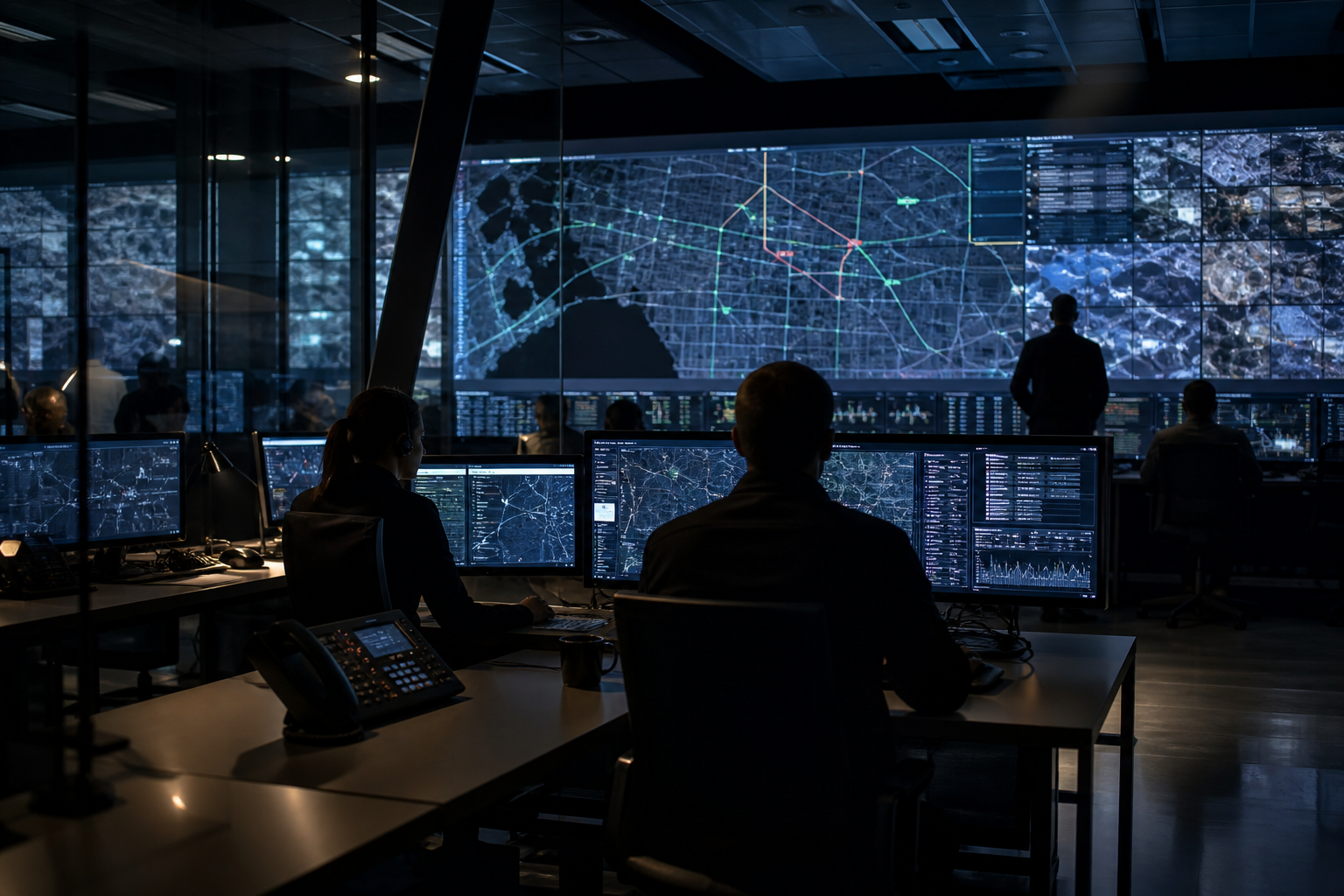
Walls of dashboards show feeds without a shared model of what may be done next — operators invent coordination that never enters the system.
- → Situation objects with belief grades: proposed, reviewed, asserted
- → Scenario proposals with itemized why-not when policy blocks a path
- → Separation of sensing, judgment, and actuation so accountability stays clear
A command surface that answers “may we act?” — not only “what happened?”
-
Civil preparedness & training programs
Drills reset to slides and tribal memory. Rare real events leave too little data for AI — so systems stay stuck in post-event learning.
- → Synthetic scenario generation against the same ontology used in live ops
- → Virtual-space rehearsal linked to physical risk models where needed
- → Self-learning loop: drill outcomes and live incidents both enrich the graph
Preparedness that learns before the next event — not only after it.
-
Multi-agency coordination programs
Central, local, and private responders each own a slice of truth — compound disasters need shared meaning without erasing agency autonomy.
- → Interoperable entities and obligations across organizational boundaries
- → Policy packs per agency role with explicit escalation and approval paths
- → Portable knowledge standards so the model is not trapped in one vendor format
Federation of judgment — one operating language without a forced monopoly stack.
Capabilities
From sparse signals to decisions you can defend
The same progression shows up across public estates: unify meaning, retrieve with evidence, encode operating judgment in policy packs, then close the loop from recommendation to approved action.
-
Personnel knowledge layer
Structure people, posts, units, careers, and policy into a governed graph. Agents consult, search, and draft against that graph — with citations — on the estate already in service.
-
Closed-environment operation
On-premise models, permissioned retrieval, and security filtering so sensitive personnel and mission data never become unconstrained generation. Existing systems remain the systems of record.
-
Preparedness & incident decision support
The same substrate rehearses compound scenarios in peacetime and flips into a control tower when an incident opens — policy-checked options with lineage for after-action review.
Engagements
From personnel support to capital-scale resilience
Attractive work lives on both sides: commands that need a trusted AI layer over personnel systems, and institutions building durable interoperability for incidents. Same ontology layer — different engagement shape.
-
Personnel decision-support programs
Commands and agencies that need evidence-grounded consultation, reporting, and talent search on a governed ontology — without replacing the systems of record.
-
Live incident & preparedness programs
Command centers that already have feeds and radios — and need Go/No-Go judgment, resource matching, and audit lineage on top of the estate they already run.
-
Cross-agency interoperability foundations
Programs standardizing meaning across jurisdictions and operators — without waiting for a full rip-and-replace of every adjacent system.
Position
The layer under the tools the market already sells
Chatbots, dashboards, and point AI each solve a slice. Automata is the ontology and policy environment those slices need — a governed layer over existing personnel and operations systems, not a replacement for them.
-
Not only a public chatbot
Keyword search over manuals still leaves relational questions unanswered. Ontology lets agents traverse people, posts, policy, and events — then return evidence, not a plausible paragraph.
-
Not a replacement personnel stack
The systems of record stay. We add a governed knowledge layer and agents that consult, report, and search against it — inside the environment those systems already occupy.
-
Not unconstrained generation
Personnel and mission answers affect people directly. Permission boundaries, source citations, and human gates keep the agent a decision-support layer — not an unsupervised speaker.
Next
Bring a command, an agency, or a public program
We’ll map the entities and constraints that already run your estate — then show where a governed knowledge layer, evidence-grounded agents, and policy packs remove the next year of one-off reconstruction. Start with a conversation; leave with a scoped outline.